Dua For Deceased — Read the Arabic dua with transliteration and meaning, and remember your loved ones who have passed away in your prayers.
Dua For Deceased | Arabic, Transliteration & Meaning
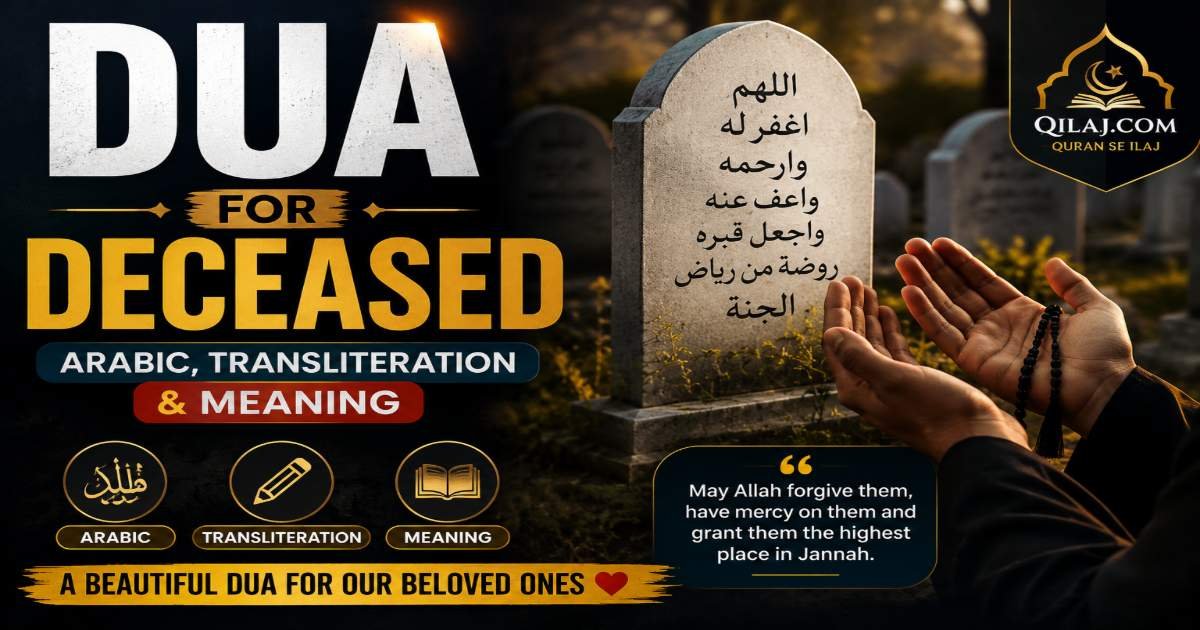
Quick answer: For a deceased Muslim, make sincere dua asking Allah for forgiveness, mercy and a good place in the Hereafter. A well-known Prophetic supplication begins اللَّهُمَّ اغْفِرْ لَهُ وَارْحَمْهُ (Allahummaghfir lahu warhamhu), meaning “O Allah, forgive him and have mercy upon him.” For a woman, the pronouns can be adjusted to the feminine form.
Allahummaghfir lahu warhamhu, wa afihi wa‘fu anhu.
English Meaning
O Allah, forgive him, have mercy upon him, grant him wellbeing and pardon him.
Best Time to Read
You can read this dua when remembering a deceased Muslim, during funeral prayer according to its method, and in personal dua. Treat this as an act of sincere understanding, not a formula with a fixed count and a guaranteed payoff.
How to Read and Practise It
Ask Allah sincerely for forgiveness and mercy for the deceased.
Use the masculine or feminine wording according to the person.
Remember that funeral prayer has its own established method; learn it from a qualified teacher.
Do not make claims about a dead person’s final status without evidence.
Support the family with practical kindness and patience.
Why Make Dua for the Deceased?
Death does not remove a believer’s need for Allah’s mercy. Muslims are encouraged to pray for deceased believers, asking Allah to forgive them, have mercy upon them and grant them peace. Dua also helps the living process grief in a worshipful way.
For readers searching for dead dua, the practical lesson is simple: keep the remembrance connected to the situation, learn the wording carefully, and let the meaning influence your actions. The dua is a form of turning to Allah, so it should increase humility, hope, patience and responsible behaviour rather than superstition or dependence on a formula.
Dua for the Dead in Arabic and Meaning
The short supplication asks Allah to forgive and have mercy on the deceased. The full Prophetic supplications contain additional requests such as pardon, honourable reception and protection from the punishment of the grave and Fire. Learn them from reliable hadith sources.
Dua for a Deceased Man or Woman
Arabic pronouns can change depending on whether the deceased is male or female. If you are not comfortable with the grammar, a qualified teacher can help. The important thing is sincere prayer rather than worrying excessively about minor pronunciation while grieving.
Funeral Prayer and Dua
Salat al-Janazah includes supplication for the deceased and has a specific structure. If you are learning Janazah prayer, follow a reliable local scholar or mosque. Avoid presenting one local variation as the only possible form when recognised differences exist.
How Family Can Support One Another
After a death, practical support matters. Help with meals, communication, errands and other responsibilities. Give the grieving family space and compassion. Avoid turning grief into arguments about minor matters. Make dua and speak gently.
What Can You Ask Allah for the Deceased?
Ask for forgiveness, mercy, pardon, a spacious grave, light, safety and entry into Jannah, using established supplications. You may also ask Allah to comfort the surviving family and reward them for patience.
Longer versions of this dua found in Sahih Muslim also ask Allah to expand the deceased’s grave, wash away their sins with water, snow and ice, and replace their home with a better one in Paradise. Different reciters may use the shorter or longer version; both come from the same authentic hadith.
Final Takeaway
In short, this dua for deceased – اللَّهُمَّ اغْفِرْ لَهُ وَارْحَمْهُ، وَعَافِهِ وَاعْفُ عَنْهُ (“Allahummaghfir lahu warhamhu, wa afihi wa‘fu anhu”), meaning “O Allah, forgive him, have mercy upon him, grant him wellbeing and pardon him” – is easy to learn and easy to keep close. Understand it, recite it sincerely, and pair it with genuine effort rather than treating it as a shortcut.
Source and Authenticity
The funeral dua, “Allahummaghfir lahu warhamhu wa ‘afihi wa’fu ‘anh…” (O Allah, forgive him, have mercy on him, keep him safe and pardon him), is recorded in Sahih Muslim (920), narrated by Awf ibn Malik, who described the Prophet ﷺ reciting this dua in a funeral prayer at length. This is a well-attested and authentic narration used across the Muslim world for Salat al-Janazah.
Common Mistakes to Avoid
A common error is assuming this dua is only for the formal funeral prayer and cannot be recited privately when thinking of a deceased loved one; while the funeral prayer context is specific, making dua for the deceased more broadly is encouraged at any time. Another mistake is adding invented claims about the dua’s effect, such as guaranteeing a specific outcome in the grave, beyond what the hadith itself states. It’s also worth avoiding neglect of ongoing good deeds on behalf of the deceased — charity and dua together are emphasized in Islamic teaching, not dua alone.
Ongoing Good Deeds for the Deceased
Alongside dua, Islamic teaching describes several forms of ongoing benefit (sadaqah jariyah) a person can direct toward a deceased loved one, based on a hadith in Sahih Muslim listing three things whose reward continues after death: ongoing charity, beneficial knowledge left behind, and a righteous child who prays for them. Many families combine dua for the deceased with actions such as giving charity on their behalf, completing an unfulfilled vow if there was one, or arranging for Qur’an to be read and its reward gifted to them — practices scholars generally consider well supported, alongside continuing to make sincere, regular dua using the wording described above.
Related Islamic Resources
Explore these related Qilaj guides for more practical Islamic learning:
You can ask Allah to forgive the deceased, have mercy on them, raise their rank, pardon their shortcomings and grant them peace in the hereafter.
Can I make dua for deceased parents?
Yes. Making dua for deceased parents and asking Allah to forgive and have mercy on them is a meaningful act of remembrance.
When can I make dua for the deceased?
You can make dua at any suitable time, including after prayers and when remembering the person.
Can I make dua for someone who was not a close relative?
Yes. You may sincerely ask Allah this a deceased Muslim.
Can I give charity on behalf of the deceased?
There are recognised Islamic teachings regarding charity on behalf of a deceased person. For detailed fiqh questions, follow a trusted scholar or school of jurisprudence.
Can non-Muslims be included in dua for the deceased?
Scholarly opinion generally holds that specific forgiveness duas for the deceased are intended for deceased Muslims. General good wishes or dua for a non-Muslim’s family during grief are a separate matter and viewed differently by scholars.