Quick answer: The key authentic Ramadan duas are the iftar dua Dhahabaz-zama’u wabtallatil-‘uruqu wa thabatal-ajru in sha Allah (Abu Dawud 2357, hasan) and the Laylatul Qadr dua Allahumma innaka ‘afuwwun tuhibbul-‘afwa fa’fu ‘anni (Tirmidhi 3513, sahih). Beyond fixed wordings, the Prophet ﷺ said the fasting person’s dua at the time of breaking the fast is not rejected, so Ramadan is the best season to ask Allah for anything in your own words.
🕋 Qilaj Islamic Activity Center
Sirf 1 minute: Qurani Hal, Tasbih ya Islamic Quiz start karein
آپ کی پریشانی کیا ہے؟
📿 33 Tasbih Challenge
33 bar SubhanAllah complete karein
🧠 Islamic Quiz Challenge
1. Iftar Dua (Roza Kholne ki Dua)
ذَهَبَ الظَّمَأُ وَابْتَلَّتِ الْعُرُوقُ وَثَبَتَ الْأَجْرُ إِنْ شَاءَ اللَّهُ
Transliteration: Dhahabaz-zama’u wabtallatil-‘uruqu wa thabatal-ajru in sha Allah.
English: The thirst has gone, the veins are moistened, and the reward is confirmed, if Allah wills.
اردو: پیاس چلی گئی، رگیں تر ہو گئیں اور اجر ثابت ہو گیا، اگر اللہ نے چاہا۔
When: after breaking the fast with dates or water. Source: Ibn Umar – Sunan Abi Dawud 2357, graded hasan.
The popular wording Allahumma laka sumtu wa ‘ala rizqika aftartu (O Allah, for You I fasted and with Your provision I broke my fast) is in Abu Dawud 2358, but its chain is mursal and graded weak; reading it is not wrong as a general dua, but the hasan wording above is stronger. For full iftar adab, see our iftar ki dua guide, and after the meal read the dua after eating.
2. Laylatul Qadr Dua
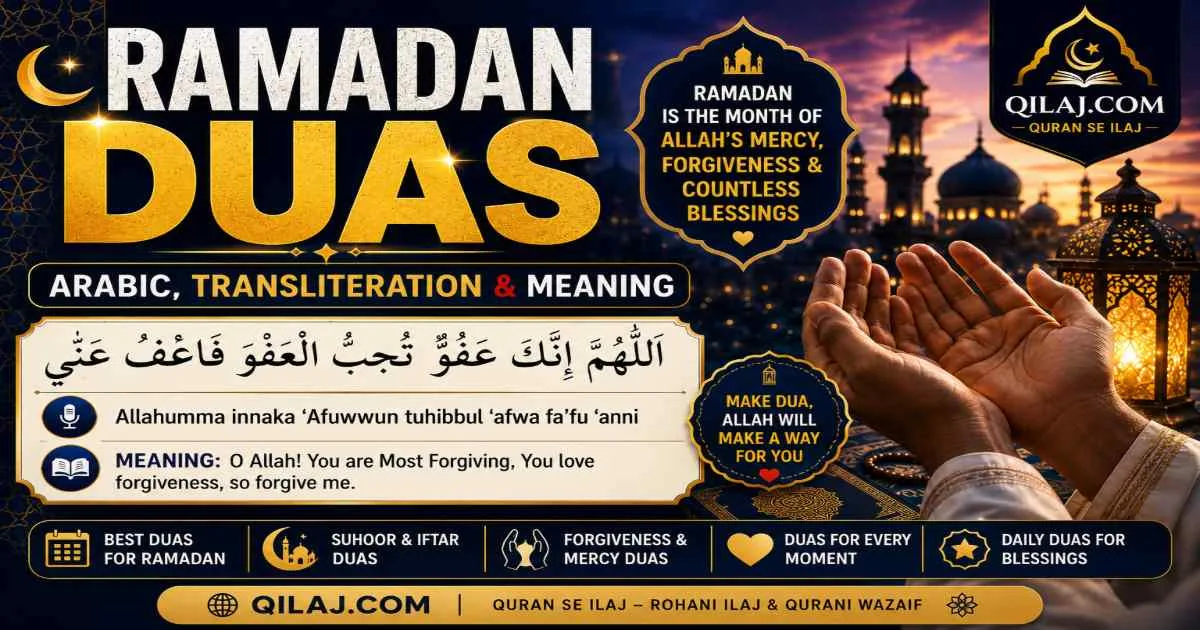
اللَّهُمَّ إِنَّكَ عَفُوٌّ تُحِبُّ الْعَفْوَ فَاعْفُ عَنِّي
Transliteration: Allahumma innaka ‘afuwwun tuhibbul-‘afwa fa’fu ‘anni.
English: O Allah, You are the Pardoner and You love to pardon, so pardon me.
اردو: اے اللہ! تو بہت معاف کرنے والا ہے، معاف کرنا تجھے پسند ہے، پس مجھے معاف فرما دے۔
When: especially on the odd nights of the last ten days. Source: ‘Aishah asked what to say if she found Laylatul Qadr, and the Prophet ﷺ taught her this – Jami’ at-Tirmidhi 3513. Some printed copies add the word karimun; scholars note it is not in the earliest manuscripts. More details are in our Laylatul Qadr ki dua article.
3. Dua on Sighting the Ramadan Moon
اللَّهُمَّ أَهْلِلْهُ عَلَيْنَا بِالْيُمْنِ وَالْإِيمَانِ وَالسَّلَامَةِ وَالْإِسْلَامِ، رَبِّي وَرَبُّكَ اللَّهُ
Transliteration: Allahumma ahlilhu ‘alayna bil-yumni wal-iman, was-salamati wal-Islam, Rabbi wa Rabbukallah.
English: O Allah, bring it upon us with blessing and faith, safety and Islam. My Lord and your Lord is Allah.
اردو: اے اللہ! اس چاند کو ہم پر برکت، ایمان، سلامتی اور اسلام کے ساتھ طلوع فرما۔ (اے چاند) میرا اور تیرا رب اللہ ہے۔
Source: Tirmidhi 3451 – Tirmidhi called it hasan gharib; the Darussalam edition grades it weak, while other routes support it. It is said on seeing any new crescent, not only Ramadan’s.
4. Suhoor and the Intention (Niyyah) for Fasting
The intention to fast is in the heart; there is no authentic hadith with a fixed spoken suhoor dua. The commonly printed phrase wa bi-sawmi ghadin nawaytu min shahri Ramadan is a scholarly formulation to help people make the intention, not a Sunnah text. Waking for suhoor itself carries blessing.
When Is Dua Most Accepted in Ramadan?
- At iftar: the fasting person is among three whose dua is not rejected (Tirmidhi 3598, hasan).
- Between adhan and iqamah (Abu Dawud 521, sahih) – check the timings on our prayer times page.
- The last third of the night at suhoor time and in Tahajjud.
- During Taraweeh and Witr – see Taraweeh ki namaz ka tarika and Dua-e-Qunoot.
Allah placed the verse about answering dua in the middle of the fasting verses: “And when My servants ask you about Me, I am near; I respond to the call of the caller when he calls upon Me” (Quran 2:186), right after mentioning that the Quran was revealed in Ramadan (2:185).
What About the Ashra (10-day) Duas?
Many calendars list separate duas for the first, second and third ashra (mercy, forgiveness, safety from the Fire). These wordings are good general duas, but the hadith dividing Ramadan into these three parts is graded weak by many scholars, so do not treat them as required. The authentic promise is general: whoever fasts Ramadan with faith and hoping for reward is forgiven his previous sins (Sahih al-Bukhari 1901).
Practical Ramadan Dua Plan
- Keep a written list of personal duas – for yourself, parents (see dua for parents), family and the Ummah.
- Spend the last 10–15 minutes before iftar in dua instead of the kitchen if possible.
- In the last ten nights, repeat the Laylatul Qadr dua and the Dua of Yunus.
- Guard the tongue – fasting is not only from food.
خلاصہ: افطار کی صحیح دعا «ذَهَبَ الظَّمَأُ وَابْتَلَّتِ الْعُرُوقُ وَثَبَتَ الْأَجْرُ إِنْ شَاءَ اللَّهُ» (ابو داؤد 2357) اور شبِ قدر کی دعا «اللَّهُمَّ إِنَّكَ عَفُوٌّ تُحِبُّ الْعَفْوَ فَاعْفُ عَنِّي» (ترمذی 3513) ہے۔ روزہ دار کی افطار کے وقت دعا رد نہیں ہوتی۔
Related Reading
FAQ
What is the authentic dua for breaking the fast?
Dhahabaz-zama’u wabtallatil-‘uruqu wa thabatal-ajru in sha Allah (Abu Dawud 2357, hasan), said after breaking the fast.
Is Allahumma laka sumtu authentic?
It is in Abu Dawud 2358 but its chain is graded weak. It may be read as a general dua, but the Abu Dawud 2357 wording is stronger.
What dua should I read on Laylatul Qadr?
Allahumma innaka ‘afuwwun tuhibbul-‘afwa fa’fu ‘anni, taught to ‘Aishah (Tirmidhi 3513).
Is there a fixed dua for suhoor?
No authentic hadith gives a fixed spoken suhoor dua. The intention to fast is made in the heart.
When is dua accepted in Ramadan?
At the time of breaking the fast, between adhan and iqamah, in the last third of the night and on Laylatul Qadr.
Source & review: References: Quran (quran.com 2:185–186), Hadith (sunnah.com: Abu Dawud 2357, 2358, 521; Tirmidhi 3513, 3451, 3598; Bukhari 1901). Content reviewed by Qilaj editorial team.