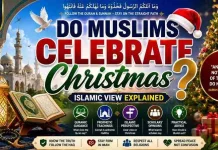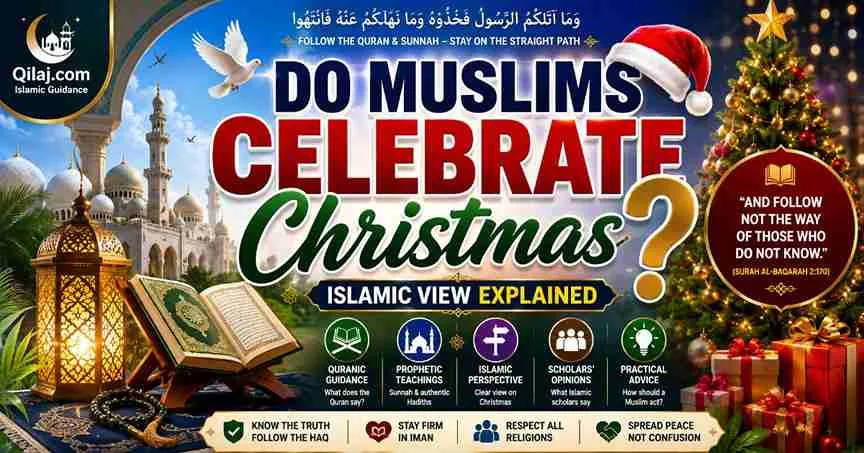
Do Muslims celebrate Christmas? No — Christmas is not an Islamic festival, and most Muslims do not celebrate it as a religious occasion. Muslims love and honour Prophet Isa (Jesus, peace be upon him) as one of Allah’s greatest messengers, but they do not believe he is divine, and Islam gives Muslims two festivals of their own: Eid al-Fitr and Eid al-Adha. At the same time, Islam teaches kindness and fairness toward Christian neighbours, colleagues and relatives, so scholars discuss questions such as greetings, gifts and office parties in detail — and they do not all give the same answer.
🕋 Qilaj Islamic Activity Center
Sirf 1 minute: Qurani Hal, Tasbih ya Islamic Quiz start karein
آپ کی پریشانی کیا ہے؟
📿 33 Tasbih Challenge
33 bar SubhanAllah complete karein
🧠 Islamic Quiz Challenge
This guide explains the Islamic view of Christmas with Quran and hadith references, presents the main scholarly opinions fairly, and gives practical advice for Muslim families in the USA, UK, Canada and elsewhere.
Urdu khulasa: کیا مسلمان کرسمس مناتے ہیں؟ کرسمس اسلامی تہوار نہیں۔ مسلمان حضرت عیسیٰ علیہ السلام کو اللہ کا عظیم رسول مانتے ہیں، مگر ان کی الوہیت کو نہیں مانتے۔ مسلمانوں کی دو عیدیں ہیں — عید الفطر اور عید الاضحیٰ۔ غیر مسلم پڑوسیوں سے حسنِ سلوک اسلام کی تعلیم ہے۔
What Is Christmas?
Christians observe Christmas on 25 December (7 January in many Orthodox churches) to mark the birth of Jesus, whom most Christian denominations believe to be the Son of God. In Western countries it has also become a large cultural holiday with gifts, family meals, lights, trees and school events. This mix of religious meaning and secular culture is exactly why Muslims ask how far they can take part.
Who Is Prophet Isa (AS) in Islam?
Belief in Jesus is part of Islamic faith. A Muslim believes in his miraculous birth to Maryam (Mary) without a father, his miracles by Allah’s permission, and his message of worshipping Allah alone. Belief in all of Allah’s messengers is one of the six articles of faith (Iman), so rejecting Isa (AS) is not possible for a Muslim.
إِنَّمَا الْمَسِيحُ عِيسَى ابْنُ مَرْيَمَ رَسُولُ اللَّهِ
“The Messiah, Jesus, son of Mary, was only a messenger of Allah.” — Surah An-Nisa 4:171
The Quran also quotes Isa (AS) speaking about his own birth: “Peace be upon me the day I was born, the day I die, and the day I will be raised back to life” (Surah Maryam 19:33). An entire chapter, Surah Maryam, is named after his mother. So the Muslim position on Christmas is not about disrespecting Jesus or Mary; it is about Tawheed — worshipping Allah alone.
Do Muslims Celebrate Christmas? The Islamic Answer
Scholars of all major schools agree that Christmas is not a Muslim religious festival and that Muslims should not take part in its religious rituals, such as church services, nativity worship or hymns that call Jesus divine. Three main evidences are cited:
- Islam has its own festivals. Anas ibn Malik (RA) reported that when the Prophet ﷺ came to Madinah, its people had two days of celebration from pre-Islamic times. He said Allah had replaced them with something better: the Day of Sacrifice and the Day of Breaking the Fast (Sunan Abi Dawud 1134, graded sahih by al-Albani).
- Theology. Christmas celebrates the birth of one believed to be the Son of God, which the Quran rejects (4:171).
- Distinct identity. The hadith “He who copies any people is one of them” (Sunan Abi Dawud 4031) is understood by scholars to warn against adopting the religious symbols and rites of other faiths.
The two Eids — Eid al-Fitr after Ramadan and Eid al-Adha during the Hajj season — are the festivals Muslims celebrate. You can learn the method of the Eid prayer in our guide to Eid ki Namaz ka Tarika.
Kindness Toward Christians: What the Quran Says
Not celebrating Christmas does not mean being cold or hostile. Allah says that He does not forbid Muslims from being kind and fair to those who have not fought them because of religion or driven them from their homes, “Surely Allah loves those who are fair” (Surah Al-Mumtahanah 60:8). The short principle of Surah Al-Kafirun — لَكُمْ دِينُكُمْ وَلِيَ دِينِ, “For you is your religion, and for me is my religion” (109:6) — sums up the balance: clear faith, peaceful coexistence.
Islamic history offers examples of this balance. The books of Seerah report that a Christian delegation from Najran visited the Prophet ﷺ in Madinah and held a respectful discussion about Isa (AS). Historians also report that Caliph Umar (RA) guaranteed the safety of Jerusalem’s Christians and their churches. In both cases Muslims were hospitable and just without adopting the other community’s worship.
Can Muslims Say “Merry Christmas”? The Scholarly Views
This is where scholars differ, and readers should know both positions:
- Majority / classical view: Many classical and contemporary scholars, including Ibn al-Qayyim in Ahkam Ahl al-Dhimmah, held that congratulating people on a religious festival of another faith is not allowed, because it implies approval of the belief being celebrated.
- Minority / contemporary view: Some contemporary scholars and bodies working with Muslims in the West, such as the European Council for Fatwa and Research, have said a general seasonal greeting is permissible as courtesy — especially in reply to a greeting — as long as the Muslim does not affirm the belief or join the worship.
Many Muslims who want to stay on the safe side use neutral words that are polite and true:
- “Wishing you and your family peace and good health.”
- “Enjoy your holidays and have a restful break.”
- “Thank you — all the best to you and your family.”
Christmas Gifts, Office Parties and Family Visits
Can Muslims accept Christmas gifts?
Most scholars permit accepting a gift from a non-Muslim neighbour or colleague as a gesture of goodwill, as long as the item is halal and is not a religious object such as a cross or nativity figure. Giving gifts at another time of year, or at Eid, is a good way to return the kindness.
Can Muslims attend Christmas parties?
Scholars generally advise declining events that are religious in nature (services, carols, worship). For a work lunch or end-of-year gathering, some scholars allow attending for professional relations if there is no alcohol, no religious ritual and halal food is available; others advise avoiding even these if they are held specifically for the festival. When unsure, ask a trusted local scholar and make Istikhara.
Reverts with Christian families
Islam strongly commands good treatment of parents, even non-Muslim parents. A revert can visit family, share a halal meal and show love during the holidays while politely excusing themselves from prayers and religious rituals. Patience and good manners often speak louder than arguments.
Teaching Children About Christmas
Children in Western schools see Christmas everywhere, and it is natural for them to feel left out. Practical tips for parents:
- Acknowledge their feelings: lights and decorations look nice, and every faith has its own special days.
- Tell them the Quranic story of Isa (AS) and Maryam so they know Muslims love Jesus too.
- Make Eid unforgettable — new clothes, gifts, decorations and outings — so children are proud of their own festivals.
- Speak to teachers early if you want an alternative activity during religious school events.
Families who teach at home can find structured ideas in our Islamic homeschooling curriculum guide.
Strengthening Faith During the Holiday Season
The winter break is a good time to strengthen worship rather than feel pressure. Keep your five daily prayers on time with our prayer times tool, add the night prayer using our Tahajjud guide, and read the verses about Isa (AS) yourself with the Quran Ayat Search tool.
Related reading
- Do Muslims Celebrate Easter? Islamic View Explained
- Do Muslims Celebrate Thanksgiving? Islamic View Explained
- The Five Pillars of Islam
FAQ
Do Muslims believe in Jesus?
Yes. Muslims believe Jesus (Prophet Isa, peace be upon him) was a great messenger of Allah, born miraculously to Maryam. They do not believe he is God or the Son of God.
Why don’t Muslims celebrate Christmas?
Because it is a religious festival based on beliefs about Jesus that Islam does not share, and because the Prophet ﷺ gave Muslims two festivals of their own: Eid al-Fitr and Eid al-Adha.
Is it haram to say Merry Christmas?
Scholars differ. Many, following the classical view, say it is not allowed because it congratulates a religious belief; some contemporary scholars permit a general courtesy greeting without affirming the belief. Neutral greetings avoid the disagreement.
Can Muslims accept Christmas gifts?
Most scholars allow accepting a halal gift given out of goodwill, as long as it is not a religious item.
What holidays do Muslims celebrate?
Muslims celebrate Eid al-Fitr at the end of Ramadan and Eid al-Adha during the Hajj season. Friday (Jumu’ah) is also a weekly day of special worship.
Source & review: References: Quran (quran.com), Hadith (sunnah.com). Further reading: IslamQA. Content reviewed by Qilaj editorial team. For a personal situation, please consult a qualified local scholar.