Do Muslims Celebrate Easter? Islamic View Explained
Do Muslims celebrate Easter? This question becomes a central topic of discussion every year, especially for millions of Muslim families living across America, Canada, the United Kingdom, Europe, and Australia. During the spring season, public spaces are filled with Easter decorations, schools arrange seasonal events, and colorful Easter eggs appear in shops. For Muslim children immersed in this environment, it naturally triggers questions about why their families do not participate in these festivities.
🕋 Qilaj Islamic Activity Center
Sirf 1 minute: Qurani Hal, Tasbih ya Islamic Quiz start karein
آپ کی پریشانی کیا ہے؟
📿 33 Tasbih Challenge
33 bar SubhanAllah complete karein
🧠 Islamic Quiz Challenge
Addressing this inquiry requires a careful balance of theological clarity, mutual respect, and profound knowledge. In the Islamic faith, Prophet Isa (Jesus), peace be upon him, is revered as one of the greatest messengers of God. While honoring his legacy is a non-negotiable pillar of faith for every believer, celebrating Easter contradicts fundamental Islamic theology. Understanding the islamic view of easter allows Muslims to maintain a clear religious identity while coexisting peacefully in pluralistic societies.
What Is Easter? A Blend of Faith and Culture
Theologically, Easter is arguably the most sacred festival on the Christian calendar. It commemorates the crucifixion, death, and subsequent resurrection of Jesus Christ, whom Christians believe to be the Son of God or God incarnate. In modern Western society, however, the holiday has also taken on a secular, commercial dimension. Today, it is widely celebrated through family dinners, chocolate bunnies, colorful egg hunts, and spring-themed community gatherings.
This overlapping of sacred rituals and secular entertainment often creates ambiguity for Muslims. Some might assume that joining a seasonal dinner or allowing children to participate in a school egg hunt is a harmless social gesture. However, in Islamic jurisprudence, the root meaning and theological implications of an event are highly critical. Understanding how islam and easter intersect textually is vital before deciding to participate.
Who Is Prophet Isa (AS) in Islam?
A widespread misconception is that Muslims do not recognize or value Jesus. In reality, prophet isa islam holds an incredibly elevated, honorable position. Believing in his prophetic mission, his miraculous virgin birth, and the miracles he performed by the permission of God is an indispensable part of a Muslim’s faith. Rejecting Jesus expels a person from the fold of Islam.
The Quranic Status of Jesus
The Quran defines the true status of Jesus with absolute clarity, honoring his humanity and prophet-hood while firmly rejecting any claims of divinity or divine sonship. Allah states in the Quran:
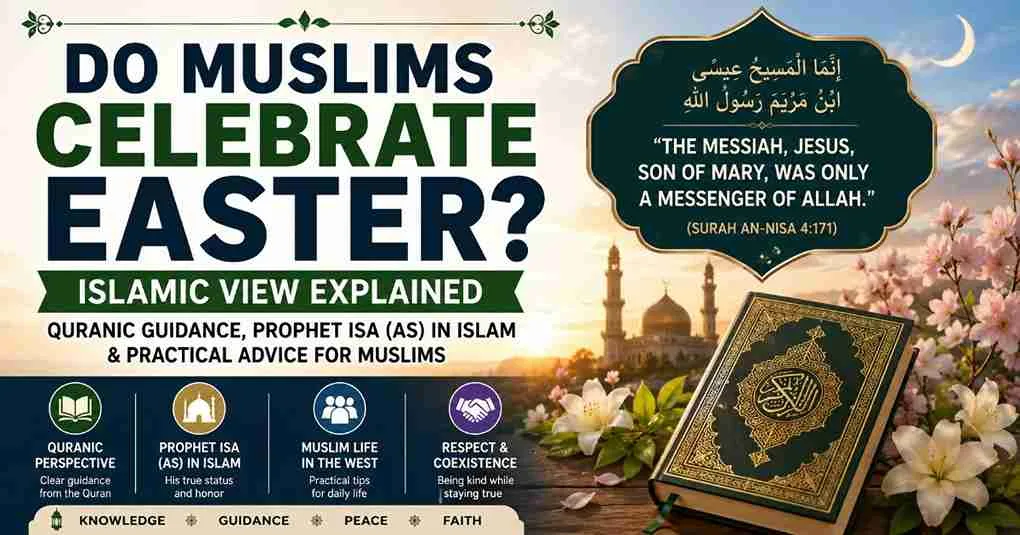
إِنَّمَا الْمَسِيحُ عِيسَى ابْنُ مَرْيَمَ رَسُولُ اللَّهِ
“The Messiah, Jesus, son of Mary, was only a messenger of Allah.”
— (Surah An-Nisa, 4:171)
This verse establishes the foundation of muslim easter beliefs. Muslims love and defend the honor of Jesus as a prophet, but they restrict all forms of worship exclusively to Allah alone—the core Islamic principle of Tawheed (pure monotheism).
The Ultimate Honor of Maryam (Mary)
Islam similarly holds his mother, Maryam (Mary), in the highest esteem, declaring her the most pure and chosen woman in human history. In fact, the 19th chapter of the Quran—Surah Maryam—is named directly after her. This demonstrates that the Islamic boundary regarding Christian holidays is not born out of disrespect, but rather out of a strict adherence to monotheistic limits.
Why Muslims Do Not Celebrate Easter: The Theological Disconnect
The core reason why muslims do not celebrate easter lies in a profound theological difference regarding the events at the end of Jesus’s earthly life. The entire premise of Easter rests on the belief that Jesus was crucified, died for human sins, and was resurrected three days later.
The Islamic Stance on the Crucifixion
The Quran explicitly rejects the crucifixion and killing of Prophet Isa (AS), declaring that Allah protected his noble messenger from humiliation and raised him up to the heavens alive. Allah states:
وَمَا قَتَلُوهُ وَمَا صَلَبُوهُ وَلَٰكِن شُبِّهَ لَهُمْ
“And they did not kill him, nor did they crucify him; but another was made to resemble him to them.”
— (Surah An-Nisa, 4:157)
Because Easter celebrates theological concepts (crucifixion and resurrection) that are directly countered by the text of the Quran, a Muslim cannot participate in the holiday. Doing so would mean validating an event that Islamic scripture explicitly states did not occur.
Islamic Holidays: True Celebrations for Believers
Islam is a self-contained and complete way of life. It does not require its adherents to borrow holidays from other theological systems. Muslims are blessed with two major annual festivals established through divine revelation and the Sunnah of Prophet Muhammad ﷺ:
- Eid al-Fitr: The festival of breaking the fast, observed at the conclusion of the holy month of Ramadan.
- Eid al-Adha: The festival of sacrifice, celebrated during the completion of the annual Hajj pilgrimage.
These days are rich with deep spiritual meaning, charity, communal prayers, family bonding, and immense gratitude to Allah. Cultivating a deep sense of joy around these Eids ensures that children grow up feeling fulfilled within their own faith.
Historical Precedent: The Christian Delegation of Najran
An extraordinary historical example of how Islam models interfaith relations is the arrival of the Christian scholars and leaders of Najran to the city of Madinah. Prophet Muhammad ﷺ welcomed them warmly, accommodated them inside his own prophetic mosque, and even permitted them to perform their Christian prayers within the mosque courtyard.
While the Prophet ﷺ demonstrated unparalleled hospitality, respect, and diplomatic courtesy, he did not join in their religious services or embrace their beliefs. This historical event provides a timeless lesson for modern Muslims: we can be exceptionally hospitable and kind to our Christian neighbors without adopting or celebrating their religious milestones.
Historical Precedent: Caliph Umar (RA) in Jerusalem
When the second Caliph of Islam, Umar ibn al-Khattab (RA), peacefully took custody of Jerusalem, the Christian Patriarch invited him to pray inside the Church of the Holy Sepulchre. Umar (RA) politely declined, stating that if he prayed inside, future generations of Muslims might mistakenly convert the church into a mosque or compromise its Christian identity.
Umar (RA) signed a treaty protecting Christian lives, churches, and cross symbols, but kept Islamic worship entirely distinct. This clearly illustrates that protecting someone’s right to celebrate their faith does not mean merging your worship with theirs.
Can Muslims Say “Happy Easter”?
Mainstream Islamic scholarship advises Muslims against using explicitly religious greetings such as “Happy Easter.” This caution stems from the linguistic meaning of the phrase, which effectively congratulates the recipient on the resurrection of Christ—a core doctrine that directly contradicts the Quran.
To remain polite, warm, and neighborly without compromising theological boundaries, Muslims can opt for neutral, respectful well-wishes such as:
- “I hope you enjoy your spring holiday break.”
- “Wishing you and your family safety, peace, and good health.”
- “Thank you for your kindness, have a restful long weekend.”
- “Warm wishes to you and your family during this season.”
Can Muslims Accept or Exchange Easter Gifts?
If a non-Muslim coworker, neighbor, or school friend offers a gift (such as general chocolates or sweets) as a goodwill gesture, many scholars state it is permissible to accept it with good manners, provided the food is Halal and free of explicit religious symbols. Accepting a kind gesture is part of building healthy community ties.
However, Muslims should refrain from buying, giving, or distributing items specifically designed for Easter celebrations, such as chocolate eggs or bunnies wrapped in Easter branding, as this constitutes an active contribution to a non-Islamic religious festival.
Can Muslim Children Join Easter Egg Hunts?
While many view egg hunts as a purely cultural, secular game for children, the activity is historically and socially tethered to the Easter holiday. Participating in these school activities can easily blur the lines of religious identity for young children, leading them to view Easter as a holiday that belongs to them.
Parents are encouraged to proactively and politely communicate with school educators ahead of time. Requesting an alternative, fun activity for your child during these seasonal parties is a standard practice that schools gracefully accommodate.
Parental Guide: Discussing Easter with Loving Clarity
When Muslim children living in Western societies see the excitement surrounding Easter, they may experience a temporary feeling of missing out. Parents should address this with patience, proactive education, and creative home environments rather than anger or rigid prohibitions.
Key communication tips for parents:
* Validate their curiosity. Acknowledge that the decorations look beautiful, but explain that different religions have different special days.
* Teach them about the Quranic story of Prophet Isa (AS), explaining why we love him as a prophet but do not believe he was crucified.
* Make your own home incredibly festive during Eid. Buy beautiful outfits, exchange high-quality gifts, and create memorable traditions so children feel completely satisfied with their Islamic identity.
To establish a consistent, faith-filled learning schedule within your home, you can read our comprehensive guide on Islamic Homeschooling.
Navigating Interfaith and Reverted Muslim Families
The spring holiday season can be particularly challenging for new Muslims (reverts) who have Christian parents and extended families. Islam places immense priority on maintaining family ties and showing unconditional kindness to parents.
A reverted Muslim can absolutely visit their family, share a wholesome meal, and help their parents around the house during the holidays to show love and respect, provided they gracefully recuse themselves from any family prayers, church trips, or specific religious rituals associated with the day.
Resolving Confusing Dilemmas through Consultation and Prayer
Living as a minority can sometimes present complex social situations, such as navigating intense workplace expectations, holiday business dinners, or delicate family dynamics. When faced with a confusing situation where you are unsure how to balance faith and social harmony, turning to traditional Islamic consultation and seeking divine guidance is highly recommended.
To understand how to seek clarity from Allah during difficult choices, you can read the complete Istikhara Dua in Arabic guide.
Furthermore, if these social pressures create emotional stress or spiritual fatigue for you or your children, turning to the Quran and authentic supplications provides immense comfort and tranquility. For deeper spiritual relief and protection, you can explore the Most Powerful Dua for Shifa.
Conclusion: The Balanced Approach of Faith and Character
In conclusion, can muslims celebrate easter? The textual consensus of Islamic scholarship is clear: Muslims do not celebrate Easter because its core theological foundations directly contradict the word of Allah in the Quran.
However, maintaining our religious boundaries must never be used as an excuse to display bad manners, hostility, or arrogance. The optimal Islamic model is one of balance—absolute, unshakeable confidence in our own monotheistic belief, combined with peerless character, kindness, and peaceful citizenship alongside our neighbors of all faiths.
Why This Topic Matters for Muslims Today
Easter and Muslim belief about Isa matters because Muslims today often live, study, and work in societies where Islamic values meet wider public culture every day. A clear answer protects faith without producing unnecessary conflict. It also helps parents, students, workers, and new Muslims respond with confidence instead of confusion.
Good Islamic guidance should combine Quran, Sunnah, scholarly balance, and real-life wisdom. A Muslim should neither copy everything around them nor behave harshly toward others. The best path is confident faith with excellent character.
Scholars’ Opinions and Balanced Guidance
Scholars treat Easter as a religious festival because it is directly connected to Christian beliefs about crucifixion and resurrection. Since the Quran presents a different belief about Prophet Isa (AS), Muslims are advised not to celebrate it.
Because Muslims follow different schools and local circumstances vary, readers should consult trustworthy scholars for personal cases. Still, the general principle remains clear: protect Tawheed, maintain halal boundaries, and treat people with honesty and kindness.
Common Mistakes Muslims Make
- Calling Easter only a children’s game without considering its religious season
- Letting children join religious school activities without explanation
- Using greetings that imply approval of beliefs contrary to Islam
- Arguing harshly instead of explaining wisely
- Ignoring halal and modesty boundaries in gatherings
Practical Advice for Muslims in Western Societies
Muslim parents should communicate with schools before Easter events, request alternatives where needed, and teach the Quranic story of Prophet Isa (AS) in a loving way.
For deeper Islamic learning and family guidance, these Qilaj resources can support daily faith practice:
- Quran Word by Word Translation PDF
- Islamic Baby Names Finder
- Dua for Sick Person
- Most Powerful Dua for Shifa
- Istikhara Dua in Arabic
- Spiritual Solutions Hub
- Dreaming of Owls Interpretation
- Umar Historical Stone
FAQs About Muslims and Easter
Do Muslims believe in Jesus?
Yes. Believing in Prophet Isa (Jesus, peace be upon him) as a noble prophet and messenger of Allah is a core article of faith in Islam. Muslims also deeply revere his mother, Maryam (Mary).
Why don’t Muslims celebrate Easter?
Muslims do not celebrate Easter because it centers around the crucifixion and resurrection of Jesus—doctrines that are explicitly rejected by the Quran, which states that Jesus was neither killed nor crucified.
Can a Muslim say “Happy Easter”?
Scholars generally advise avoiding this phrase because it carries an implied endorsement of religious beliefs that conflict with Islam. Polite, secular alternative greetings are highly preferred.
Can Muslims accept Easter chocolate or gifts?
If a neighbor or colleague gives general chocolate as a kind seasonal gesture, it may be accepted with gratitude, provided it is Halal and free of explicit religious symbols.
What holidays do Muslims celebrate instead?
Muslims celebrate two primary divine festivals each year: Eid al-Fitr (marking the end of Ramadan) and Eid al-Adha (commemorating the devotion of Prophet Ibrahim).
External Reference: IslamQA – Islamic Questions and Scholarly Answers
Qilaj.com کے فری اسلامی کام میں تعاون کریں
Agar aapko Qilaj.com ke Quran learning tools, Noorani Qaida, dua healing tools, digital tasbih, Qibla finder, prayer times aur Islamic articles se faida ho raha hai, to aap is khair ke kaam me apna hissa daal sakte hain.
اگر آپ کو Qilaj.com کے قرآن لرننگ ٹولز، نورانی قاعدہ، دعا، تسبیح، قبلہ فائنڈر، نماز اوقات اور اسلامی مضامین سے فائدہ ہو رہا ہے تو آپ اس خیر کے کام میں تعاون کر سکتے ہیں۔
Note: Jo shakhs paison se madad na kar sake, woh Qilaj.com ke liye dua zaroor kare.
پاکستانی احباب JazzCash، EasyPaisa یا Meezan Bank کے ذریعے آسانی سے تعاون کر سکتے ہیں۔ بیرون ملک سے تعاون کے لیے PayPal استعمال کیا جا سکتا ہے۔