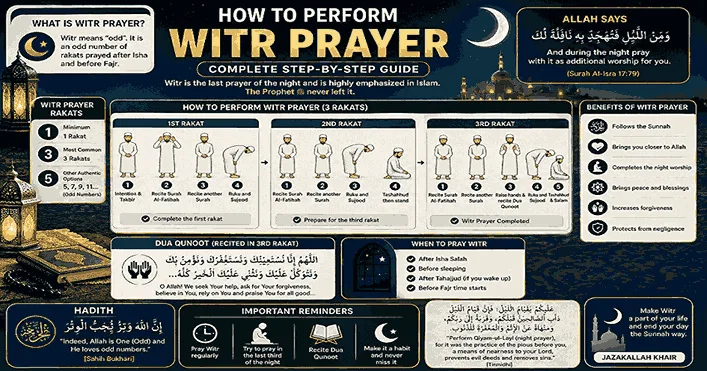
How to perform Witr prayer: Witr is an odd-numbered prayer (usually 1 or 3 rakats) offered after Isha and before Fajr begins. In the common 3-rakat method, you pray two rakats, sit for Tashahhud, stand for the third rakat, recite Al-Fatihah and a surah, then recite Dua Qunoot and finish the prayer. It is the last prayer of the night and the Prophet ﷺ strongly encouraged it.
🕋 Qilaj Islamic Activity Center
Sirf 1 minute: Qurani Hal, Tasbih ya Islamic Quiz start karein
آپ کی پریشانی کیا ہے؟
📿 33 Tasbih Challenge
33 bar SubhanAllah complete karein
🧠 Islamic Quiz Challenge
This guide explains what Witr prayer is, how many rakats it has, the step-by-step method (Hanafi and other schools), the Witr prayer dua, the best time, and answers to common questions – with references checked on sunnah.com and quran.com.
What Is Witr Prayer?
The word witr means “odd number” in Arabic. Witr prayer is prayed in an odd number of rakats after Isha and before the start of Fajr time. The Prophet ﷺ said: “Allah is single (witr) and loves what is single, so observe the witr, you who follow the Qur’an” (Sunan Abi Dawud 1416, graded sahih).
Ruling: In the Hanafi school Witr is wajib (necessary). Most other scholars (Shafi’i, Maliki, Hanbali) consider it a strongly emphasised Sunnah (sunnah mu’akkadah). All agree it should not be left out regularly.
Quran on Night Worship
وَمِنَ اللَّيْلِ فَتَهَجَّدْ بِهِ نَافِلَةً لَّكَ
Translation: “And rise at the last part of the night, offering additional prayers…” (Surah Al-Isra 17:79). Witr seals this night worship – read more in our Tahajjud prayer guide.
How Many Rakats Are in Witr Prayer?
Witr can be 1, 3, 5, 7, 9 or 11 rakats. The Prophet ﷺ said: “The witr is a duty for every Muslim, so if anyone wishes to observe it with five rak’ahs he may do so,” and he also allowed three or one (Sunan Abi Dawud 1422). He also said: “Witr is a rak’ah at the end of the prayer” (Sahih Muslim 752).
| Witr Option | Rakats | Notes |
|---|---|---|
| Minimum | 1 rakat | Valid in Shafi’i, Maliki and Hanbali schools |
| Most common | 3 rakats | The only form in the Hanafi school |
| Longer forms | 5, 7, 9 or 11 | Narrated in the Sunnah, usually with Tahajjud |
How to Perform Witr Prayer Step by Step (3 Rakats)
Below is the common 3-rakat method followed in South Asia (Hanafi). Differences in other schools are explained after it. If you need the basics of salah first, see how do you pray in Islam or namaz ka tareeqa in Urdu.
First Rakat
- Make the intention (niyyah) in your heart to pray Witr.
- Say “Allahu Akbar” (Takbir), fold your hands, and recite the opening Thana.
- Recite Surah Al-Fatihah and another surah. The Prophet ﷺ often recited Surah Al-A’la in the first rakat (Sunan an-Nasa’i 1699).
- Perform ruku and two sajdahs as normal.
Second Rakat
- Stand and recite Al-Fatihah and a surah (Surah Al-Kafirun is Sunnah here).
- Perform ruku and two sajdahs.
- Sit for the first Tashahhud (Attahiyat) only, then stand up for the third rakat.
Third Rakat and Dua Qunoot
- Recite Al-Fatihah and a surah (Surah Al-Ikhlas is Sunnah here).
- Before ruku, say “Allahu Akbar” while raising your hands to the ears, then fold them again.
- Recite the witr prayer dua – Dua Qunoot – quietly.
- Go into ruku, complete the sajdahs, sit for the final Tashahhud, Durood and Dua e Masura, and end with salam.
- After salam, it is Sunnah to say “Subhanal-Malikil-Quddus” three times (Nasa’i 1699).
Method in Other Schools
Shafi’i and Hanbali scholars usually pray Witr as 2 rakats with salam, then 1 separate rakat; praying 3 together is also allowed, but without sitting after the second rakat so that it does not resemble Maghrib. They usually recite Qunoot after rising from ruku in the last rakat. Both “before ruku” and “after ruku” have support in the Sunnah – Ubayy bin Ka’b reported the Prophet ﷺ said the Qunoot before bowing in Witr (Nasa’i 1699). Follow the method of your school and local scholars.
Witr Prayer Dua (Dua Qunoot)
Two well-known duas are recited in Witr. The one taught by the Prophet ﷺ to his grandson Al-Hasan bin Ali begins:
اللَّهُمَّ اهْدِنِي فِيمَنْ هَدَيْتَ، وَعَافِنِي فِيمَنْ عَافَيْتَ، وَتَوَلَّنِي فِيمَنْ تَوَلَّيْتَ
Allahummahdini fiman hadayt, wa ‘afini fiman ‘afayt, wa tawallani fiman tawallayt… – “O Allah, guide me among those You have guided, grant me well-being among those You have granted it, take me under Your care among those You have taken under Your care…” (Sunan Abi Dawud 1425, Jami’ at-Tirmidhi 464).
In Hanafi practice the more commonly recited version begins:
اللَّهُمَّ إِنَّا نَسْتَعِينُكَ وَنَسْتَغْفِرُكَ وَنُؤْمِنُ بِكَ وَنَتَوَكَّلُ عَلَيْكَ
For the full Arabic text of both duas with transliteration, Urdu tarjuma and English meaning, see our complete Dua e Qunoot guide. If you have not memorised it yet, you may recite another short dua such as Rabbana atina fid-dunya hasanah… (Quran 2:201) until you learn it.
When Should You Pray Witr? Do You Pray Witr After Tahajjud?
Witr time starts after the Isha prayer and lasts until Fajr begins. Check exact Isha and Fajr times for your city on our prayer times today page, and see the Isha prayer method.
The Prophet ﷺ said: “Make witr as your last prayer at night” (Sahih al-Bukhari 998). He also said that whoever fears he will not wake in the last part of the night should pray Witr in the first part, and whoever hopes to wake should pray it at the end of the night, because that is better (Sahih Muslim 755).
- If you wake for Tahajjud regularly: delay Witr and pray it after Tahajjud.
- If you are not sure you will wake: pray Witr after Isha before sleeping. If you then wake up, pray Tahajjud in pairs and do not repeat Witr.
Common Mistakes to Avoid
- Leaving Witr regularly – it is wajib in Hanafi fiqh and strongly emphasised in all schools.
- Delaying it until Fajr has started (Hanafis make it up as qaza – see qaza namaz ka tarika).
- Forgetting Dua Qunoot in the Hanafi method without doing sajda-e-sahw.
- Praying two Witrs in one night.
- Rushing through the positions without calm (khushu).
Witr Namaz – Urdu Khulasa
وتر کی نماز عشاء کے بعد اور فجر سے پہلے پڑھی جاتی ہے۔ حنفی فقہ میں وتر واجب ہے اور تین رکعت ہیں: دوسری رکعت میں قعدہ کریں، تیسری رکعت میں سورہ فاتحہ اور سورت کے بعد رکوع سے پہلے تکبیر کہہ کر دعائے قنوت پڑھیں۔ جو شخص تہجد کے لیے اٹھتا ہو وہ وتر کو رات کی آخری نماز بنائے۔
Frequently Asked Questions About Witr Prayer
What is Witr prayer?
Witr is an odd-numbered prayer offered after the Isha prayer and before Fajr time begins. It is wajib in the Hanafi school and a strongly emphasised Sunnah according to most other scholars.
How to perform Witr prayer?
In the common 3-rakat method, pray two rakats and sit for Tashahhud, then in the third rakat recite Al-Fatihah and a surah, say Allahu Akbar raising the hands, recite Dua Qunoot, and complete the ruku, sajdahs, final Tashahhud and salam.
Can I pray Witr after Tahajjud?
Yes. If you wake for Tahajjud, it is better to delay Witr and make it your last prayer of the night.
Can I pray 1 rakat Witr?
Yes, one rakat of Witr is authentically reported (Sahih Muslim 752) and is valid in the Shafi’i, Maliki and Hanbali schools. The Hanafi school prays three.
What if I forget Dua Qunoot in Witr?
In Hanafi fiqh, if you forget it, do sajda-e-sahw at the end of the prayer. In other schools Qunoot is Sunnah, so the Witr remains valid.
Related reading
Source & review: References: Quran (quran.com), Hadith (sunnah.com). Content reviewed by Qilaj editorial team. For detailed fiqh questions, consult a qualified local scholar.