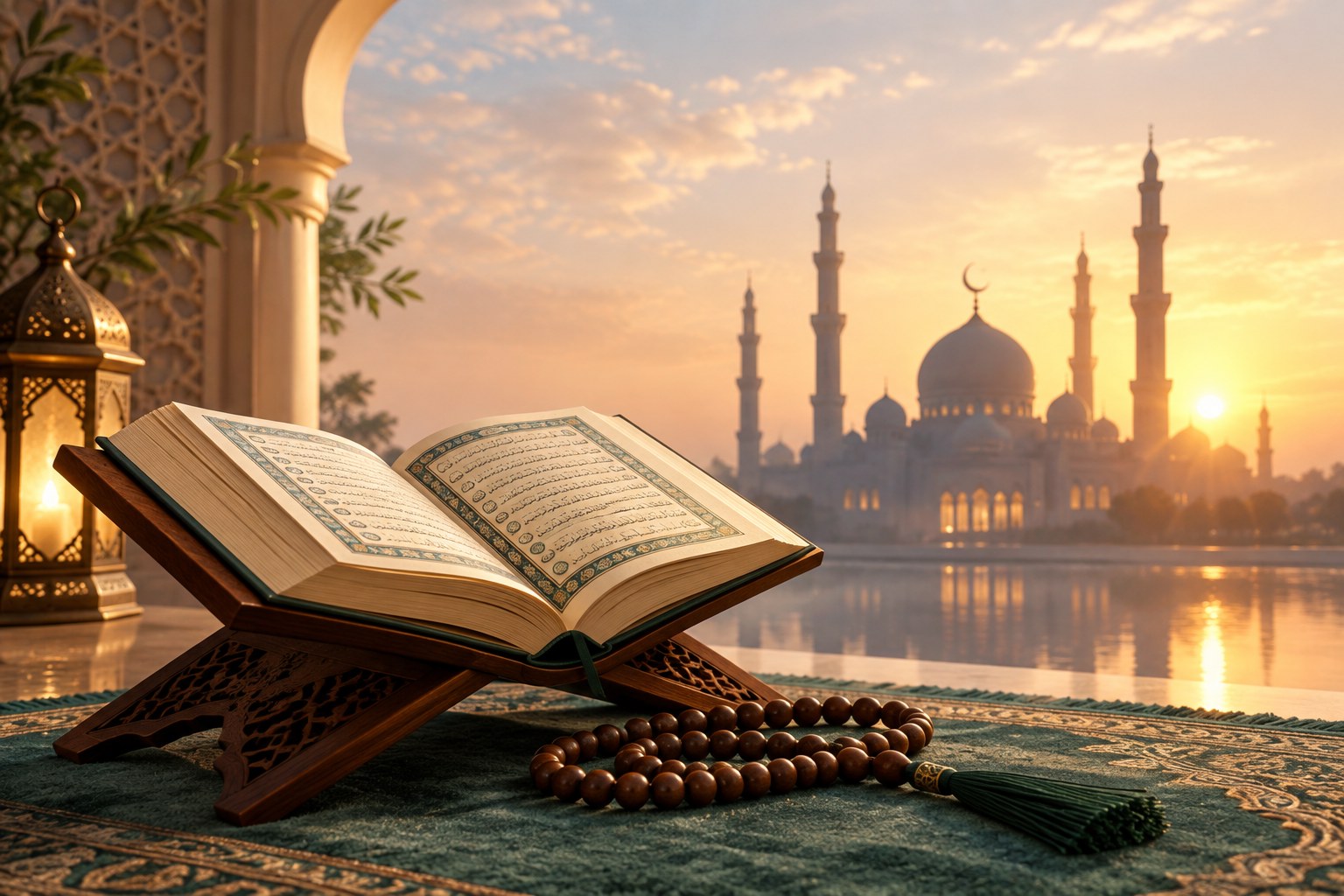
Iman (إيمان) in Islam means firm belief in the heart, confirmed by the tongue and shown in actions. The 6 articles of faith are belief in Allah, His angels, His revealed books, His messengers, the Last Day, and Divine Decree (Qadar), both its good and its bad. The Prophet ﷺ listed these six in the famous Hadith of Jibreel (Sahih Muslim 8). In Urdu they are called ایمان کے چھ ارکان and are summarised in ایمانِ مفصل.
Iman is the foundation on which worship (Ibadah), Islamic law (Shariah) and character (Akhlaq) are built. This guide explains what Iman means, each of the six articles with its Quranic evidence, how Iman relates to Islam and Ihsan, and practical ways to strengthen it.
Many people know Islam mainly through its outward acts, the Five Pillars of Islam (Arkan al-Islam). Those acts rest on the inner belief system known as the Six Pillars of Iman (Arkan al-Iman). The verbal entry point to both is the Shahadah, which you can learn with meaning in our 6 Kalma guide.
1. The Linguistic and Theological Dimensions of Iman
To understand the structure of Islamic belief, one must first look at how classical scholars analyze the word *Iman*. Linguistically, the Arabic root word Amana (أمن) signifies safety, security, trustworthiness, and absolute verification. Therefore, a person who possesses Iman is fundamentally at peace with the truth. As a result, they secure themselves against spiritual destruction and the wrath of the Creator.
Theologically, mainstream scholars of Islam (Ahl us-Sunnah wal-Jama’ah) define Iman as an integrated triad that no one can separate. It consists of three structural elements:
- Tasdeeq bil-Qalb (Belief in the Heart): The firm, unwavering internal conviction, realization, and acceptance of the absolute truths revealed by Allah, completely devoid of doubt, hesitation, or intellectual arrogance.
- Iqrar bil-Lisan (Affirmation by the Tongue): The external verbal declaration of faith, specifically pronouncing the Shahadah (testimony of faith), which legalizes a person’s status as a Muslim within the community.
- Amal bil-Arkan (Action by the Limbs): The physical manifestation of faith through righteous actions, compliance with divine laws, and avoidance of prohibitions. Therefore, actions are the natural fruit and proof of the internal Iman existing within the heart.
The Fluctuating Nature of Iman
A critical doctrine of orthodox Islamic theology states that Iman is not static; rather, it is a dynamic spiritual entity that increases and decreases. Scholars explain that it increases with acts of obedience to Allah, such as regular prayers, charity, dhikr, and seeking knowledge. Conversely, it decreases with acts of disobedience, sins, and spiritual negligence. The Holy Quran explicitly states this reality:
“The believers are only those who, when Allah is mentioned, their hearts become fearful, and when His verses are recited to them, it increases them in faith; and upon their Lord they rely.” — Surah Al-Anfal [8:2]
The Foundational Hadith of Angel Jibril
The primary textual source that establishes the structural breakdown of the Iman of Islam is the foundational narration known as the Hadith of Jibril. According to the authentic collection of Sahih Muslim, Angel Jibril appeared in the human form of a traveler. He sat closely before the Prophet Muhammad (ﷺ) and asked a sequence of paradigm-defining questions to teach the companions the levels of religion (Deen). To study the Deen in a structured way, you can explore our online Quran learning and Islamic courses.
When Angel Jibril inquired, “O Muhammad, inform me about Iman,” the Messenger of Allah (ﷺ) gave the definitive programmatic response that forms the basis of all Islamic creed:
“Iman is to believe in Allah, His angels, His books, His messengers, the Last Day, and to believe in Al-Qadar (Divine Decree), both the good and the bad thereof.” — Narrated by Umar ibn al-Khattab | Sahih Muslim 8 (Book 1, Hadith 1)
2. Detailed Exposition of the Six Pillars of Iman
To build an unshakeable spiritual foundation, we must examine each of these six pillars with academic precision. Therefore, we utilize scriptural context and philosophical breakdown below.
Pillar 1: Belief in Allah (Al-Iman billah)
Belief in Allah is the ultimate core, the absolute center, and the foundational reality of all Islamic existence. It goes beyond acknowledging that a supreme deity exists. Instead, it requires a pure, uncompromised commitment to **Tawhid** (the absolute Oneness of God). Islamic scholars classify this primary pillar into three specific operational dimensions:
- Tawhid ar-Rububiyyah (Oneness of Lordship): Believing that Allah is the sole Creator, Owner, Sustainer, Provider, and Controller of the entire cosmos. No entity shares in His administrative power over creation.
- Tawhid al-Uluhiyyah (Oneness of Worship): Directing all forms of physical and spiritual devotion, supplication, sacrifice, fear, hope, and reliance exclusively to Allah. This is the core message brought by every single Prophet. For example, Muslims establish this worship during the sacred Jummah prayer time each week.
- Tawhid al-Asma was-Sifat (Oneness of Names and Attributes): Affirming the unique names and characteristics that Allah has described Himself with in the Quran, or that the Prophet (ﷺ) has mentioned in authentic Hadith, without distorting their meaning (Tahrif), denying them (Ta’til), explaining how they manifest physically (Takyif), or comparing them to created things (Tamthil). Explore these names with meanings in our guide to the 99 Names of Allah.
The definitive Qurani evidence for the absolute uniqueness of Allah is found in Surah Al-Ikhlas:
“Say, ‘He is Allah, [who is] One. Allah, the Eternal Refuge. He neither begets nor is born, Nor is there to Him any equivalent.'” — Surah Al-Ikhlas [112:1-4]
Pillar 2: Belief in His Angels (Al-Iman bil-Malaikah)
Belief in the Angels requires a Muslim to accept the existence of a grand, highly structured, unseen creation of Allah. Angels are spiritual beings created out of light (Noor). Unlike human beings, they do not possess free will, desires, or physical needs like eating or sleeping. Their entire existence is defined by absolute, flawless obedience to the commands of Allah.
The Quran describes their dedicated nature clearly:
“They do not disobey Allah in what He commands them but do what they are commanded.” — Surah At-Tahrim [66:6]
Belief in angels involves recognizing their vast numbers and the roles described in the Quran and Hadith. Jibril and Mika’il are named in the Quran (2:98); the roles of others, such as Israfil, are known from hadith and the explanations of scholars:
| Angel Name | Primary Cosmic Assignment / Duty |
|---|---|
| Jibril (Gabriel) | The Archangel responsible for conveying divine revelation (Wahi) from Allah to the selected Prophets. |
| Mika’il (Michael) | The Angel placed in charge of directing the weather systems, rainfall, and distribution of physical sustenance to creation. |
| Israfil | The Angel tasked with blowing the colossal Trumpet (Soor) to mark the onset of the Day of Resurrection. |
| Malak al-Mawt | The Angel of Death, who along with his assistants, extracts the human soul at the exact moment of designated death. |
Pillar 3: Belief in His Revealed Books (Al-Iman bil-Kutub)
Throughout history, Allah did not leave human beings to wander blindly in intellectual or spiritual darkness. Out of His infinite mercy, He revealed sacred scriptures containing explicit laws, guidance, and parameters of truth to selected Messengers. As a fundamental component of the Iman of Islam, a believer must accept that these original books were the literal Word of Allah. To understand these deep concepts, many students utilize the Quran word by word translation PDF for academic clarity.
The core scriptures explicitly named within Islamic theology are:
- The Sahifah (Scrolls): Revealed to Prophet Ibrahim (Abraham) [A.S.].
- The Tawrat (Torah): Revealed to Prophet Musa (Moses) [A.S.].
- The Zabur (Psalms): Revealed to Prophet Dawud (David) [A.S.].
- The Injeel (Gospel): Revealed to Prophet Isa (Jesus) [A.S.].
- The Holy Quran: The final, ultimate revelation sent to the Seal of the Prophets, Muhammad (ﷺ).
An essential nuance of this pillar is that while a Muslim believes in the divine origin of all prior scriptures, Islamic theology holds that those previous texts were systematically corrupted, altered, or lost over centuries through human intervention (known as *Tahrif*). The Holy Quran, however, acts as the ultimate filter and final testament (*Muhaymin*). It remains perfectly preserved, word-for-word, because Allah Himself took the direct responsibility of protecting it:
“Indeed, it is We who sent down the Quran and indeed, We will be its guardian.” — Surah Al-Hijr [15:9]
Pillar 4: Belief in the Messengers (Al-Iman bir-Rusul)
This pillar demands an absolute belief in every single Prophet (Nabi) and Messenger (Rasul) commissioned by Allah. A *Nabi* is a prophet who received divine revelation to practice and convey within an existing law, while a *Rasul* is a messenger given a new divine book and a distinct legislative law code. The Quran names 25 prophets, and tells us that Allah sent messengers whose stories were not related to us (Quran 40:78). A narration in Musnad Ahmad mentions about 124,000 prophets, though scholars differ on the strength of its chain, so the exact number is best left to Allah.
A believer must make absolutely no distinction in terms of validating their prophetic status. Denying even a single prophet of Allah amounts to denying all of them. The Quran outlines this clearly:
“The Messenger has believed in what was revealed to him from his Lord, and [so have] the believers. All of them have believed in Allah and His angels and His books and His messengers, [saying], ‘We make no distinction between any of His messengers.'” — Surah Al-Baqarah [2:285]
Among the vast brotherhood of prophets, there exists an elite category of five resolute individuals known as **Ulul ‘Azm min ar-Rusul** (The Messengers of Strong Will). They faced monumental hardships with legendary resilience: **Prophet Nuh (Noah), Prophet Ibrahim (Abraham), Prophet Musa (Moses), Prophet Isa (Jesus), and the Leader of Humanity, Prophet Muhammad (ﷺ).** Prophet Muhammad holds the unique distinction of being the absolute *Khatam an-Nabiyyin* (The Seal and Finality of all Prophets)—no prophet or messenger will ever emerge after him until the end of time.
Pillar 5: Belief in the Last Day (Al-Iman bil-Yawm al-Akhir)
Belief in the Last Day is the massive engine that drives accountability, ethical righteousness, and justice in a Muslim’s daily life. It forces a realization that this physical life is nothing more than a temporary testing ground, an interim phase before the permanent eternity of the Hereafter (Akhirah). This comprehensive article of faith encompasses several sequential metaphysical events:
- Life in the Barzakh: The intermediate state of existence in the grave, starting immediately after biological death, where the soul experiences either preliminary comfort or punishment based on their initial questioning by the two angels, Munkar and Nakir.
- Al-Ba’th (The Resurrection): The physical re-creation and resurrection of every human being who has ever walked the earth, pulled out from their graves after the second blowing of the Trumpet by Angel Israfil.
- Al-Hashr (The Gathering): The vast assembly of all human beings on a flat, expansive plain under an intensely hot sun, standing in anticipation of divine judgment.
- Al-Hisab (The Accounting of Deeds): The absolute, perfectly just trial where Allah displays each individual’s record of deeds. The *Mizan* (Scale) will be set up to weigh the exact weight of good deeds against bad deeds. To prepare for that Day, a believer keeps returning to Allah through sincere repentance — see our guide to Tawbah and Istighfar.
- As-Sirat and the Final Abodes: Crossing the bridge suspended over Hellfire. Those with valid Iman and righteous deeds will pass over securely into **Jannah (Paradise)**—an eternal realm of ultimate peace and joy. Conversely, those who completely rejected faith will face accountability in Hellfire (**Jahannam**)—a place of severe torment and absolute justice.
The Quran continuously reminds humanity of the sudden reality of this momentous day:
“O human beings, fear your Lord. Indeed, the convulsion of the [final] Hour is a terrible thing.” — Surah Al-Hajj [22:1]
Pillar 6: Belief in Divine Decree (Al-Iman bil-Qadar)
Belief in *Al-Qadar* (Divine Decree) represents the pinnacle of intellectual submission to the infinite wisdom and sovereignty of the Almighty. It requires a firm conviction that everything that occurs within the cosmos—whether macrocosmic cosmic events or microcosmic human choices, whether perceived as good or bad, pleasant or painful—occurs in strict accordance with the pre-existent Knowledge, Will, and Creation of Allah.
Islamic orthodox theology explains that complete belief in Qadar consists of four critical, sequential levels (known as *Maratib al-Qadar*):
- Al-Ilm (Knowledge): Believing that Allah possesses absolute, flawless, and timeless knowledge of everything in existence, past, present, and future, down to the exact movement of a leaf.
- Al-Kitabah (Writing): Believing that Allah recorded all details of creation and all future historical events in the Master Divine Tablet, known as Al-Lawh al-Mahfuz (The Preserved Tablet), fifty thousand years before creating the heavens and the earth (Sahih Muslim 2653).
- Al-Mashi’ah (The Will): Believing that whatever Allah wills happens, and whatever He does not will can never happen. No force can override His supreme decree.
- Al-Khalq (Creation): Believing that Allah is the exclusive Creator of everything, including all physical matter, actions, energy, and human capacity.
The definitive proof for Qadar is stated elegantly in Surah Al-Qamar:
“Indeed, all things We created with predestination.” — Surah Al-Qamar [54:49]
It is vital to note that belief in Qadar does not cancel out human free will. Rather, Islam teaches that humans possess a delegated free will and choice, which operates within the overarching supreme Will of Allah. Consequently, humans choose their actions, and are thus held morally accountable for them.The psychological benefits of internalizing Qadar remain immense. Specifically, it completely removes despair during intense trials and prevents arrogance during times of outstanding success. As Allah states in the Quran:
“No disaster strikes upon the earth or among yourselves except that it is in a register before We bring it into being – indeed that, for Allah, is easy. In order that you not despair over what has eluded you and not exult [in pride] over what He has given you.” — Surah Al-Hadid [57:22-23]
3. The Spiritual Hierarchy: Islam, Iman, and Ihsan
To understand the full scope of Islamic spirituality, classical theologians emphasize that the religion operates on three progressive, concentric spheres of spiritual depth. These three levels form a natural hierarchy:
Level 1: Islam (The Outer Circle)
This level is defined by outward, physical submission. It consists of the physical execution of the Five Pillars: pronouncing the Shahadah, establishing Namaz, paying Zakat, fasting in Ramadan, and performing Hajj. A person at this stage is legally a Muslim, but the internal spiritual light may still be developing.
Level 2: Iman (The Core Circle)
This level marks the migration from mere physical compliance into profound intellectual and spiritual conviction. It is the internalization of the Six Articles of Faith. Therefore, every true Mu’min (believer) is a Muslim, but not every Muslim has yet elevated their heart to become a true Mu’min. As Allah clearly points out regarding the Bedouins:
“The Bedouins say, ‘We have believed.’ Say, ‘You have not [yet] believed; but say [instead], \”We have submitted,\” for faith has not yet entered your hearts.'” — Surah Al-Hujurat [49:14]
Level 3: Ihsan (The Zenith of Faith)
This level represents the absolute highest peak of the spiritual pyramid. Ihsan means perfection, excellence, and beauty in worship. As defined by Prophet Muhammad (ﷺ), Ihsan is: “To worship Allah as if you see Him; and if you cannot see Him, know that He certainly sees you.” (Sahih Muslim 8) It represents a state of constant, heightened spiritual awareness where a believer’s internal Iman perfectly shines through every movement of their lives.
4. Practical Methods to Strengthen and Cultivate Your Iman
Because Iman is highly susceptible to the pressures of worldly distractions, a Muslim must actively take care of and cultivate their spiritual status. Based on the classical traditions of Islamic theology, here are the most effective practical methods to boost your internal faith:
- Continuous Quranic Contemplation (Tadabbur): Do not just read the Arabic text blindly; instead, actively study the translation, context, and exegesis (Tafseer) of the verses. Understanding the Word of Allah increases faith within the heart; our Quran Ayat Search tool lets you look up any verse with Urdu and English translation.
- Consistency in Obligatory Worship (Fara’idh): Ensuring that your five daily prayers (Namaz) are performed punctually, with internal focus, humility, and concentration (*Khushu*). Regularity in obligatory duties provides a defensive shield against spiritual decay.
- Abundance of Constant Remembrance (Dhikr): Keeping the tongue moist with the praise of Allah, using the authentic morning and evening azkar. A digital tasbih counter can help you stay consistent. “Surely in the remembrance of Allah do hearts find comfort” (Quran 13:28).
- Seeking Authentic Sacred Knowledge: Actively dedicating time to learn the intricacies of Islamic creed (Aqeedah), prophetic history (Seerah), and jurisprudence. Learning eliminates intellectual doubts that can be planted by secular narratives.
Conclusion: The Ultimate Triumph of Sound Creed
In summary, the Iman of Islam is the definitive spiritual map that directs a human soul securely across the turbulent waters of this worldly test. By internalizing the Six Pillars of Faith—Belief in Allah, His Angels, His Books, His Messengers, the Last Day, and the Divine Decree—a Muslim achieves absolute clarity of thought, unparalleled mental resilience, and a deep, fulfilling sense of spiritual peace.
As you strive to learn, grow, and perfect your practice of faith, ensure that your information is derived exclusively from verified, authentic scholarly channels. Keeping your theological foundation pure remains the ultimate safeguard for your Hereafter.
Frequently Asked Questions (FAQ)
Q1: What is the primary difference between Islam and Iman?
Islam refers to the outward physical submission and actions, such as performing Namaz, fasting, and paying Zakat. Conversely, Iman represents the internal spiritual conviction and absolute belief of the heart in the core tenets of faith, as outlined in the Hadith of Jibril.
Q2: What are the 6 pillars of Iman in Islam?
The six articles of faith are: Belief in Allah (Tawhid), His Angels (Malaikah), His Revealed Books (Kutub), His Messengers (Rusul), the Last Day (Yawm al-Akhir), and the Divine Decree (Al-Qadar).
Q3: Does Iman increase and decrease over time?
Yes, according to mainstream orthodox Islamic theology, Iman is dynamic. It systematically increases with righteous deeds, active obedience, and constant dhikr, whereas it decreases through sins, negligence, and spiritual corruption.
Q4: Why is the belief in Al-Qadar (Divine Decree) so important?
Belief in Qadar brings immense mental peace and spiritual resilience to human beings. Furthermore, it reminds a believer that everything manifests according to Allah’s infinite wisdom, which eliminates despair during failure and prevents pride during success.
Q5: Who are the elite messengers known as Ulul ‘Azm?
In addition to the vast brotherhood of prophets, the five elite messengers of strong will are Prophet Nuh (Noah), Prophet Ibrahim (Abraham), Prophet Musa (Moses), Prophet Isa (Jesus), and the final Messenger, Prophet Muhammad (ﷺ).
Source & review: References: Quran (quran.com), Hadith (sunnah.com: Muslim 8, Muslim 2653). Content reviewed by Qilaj editorial team.